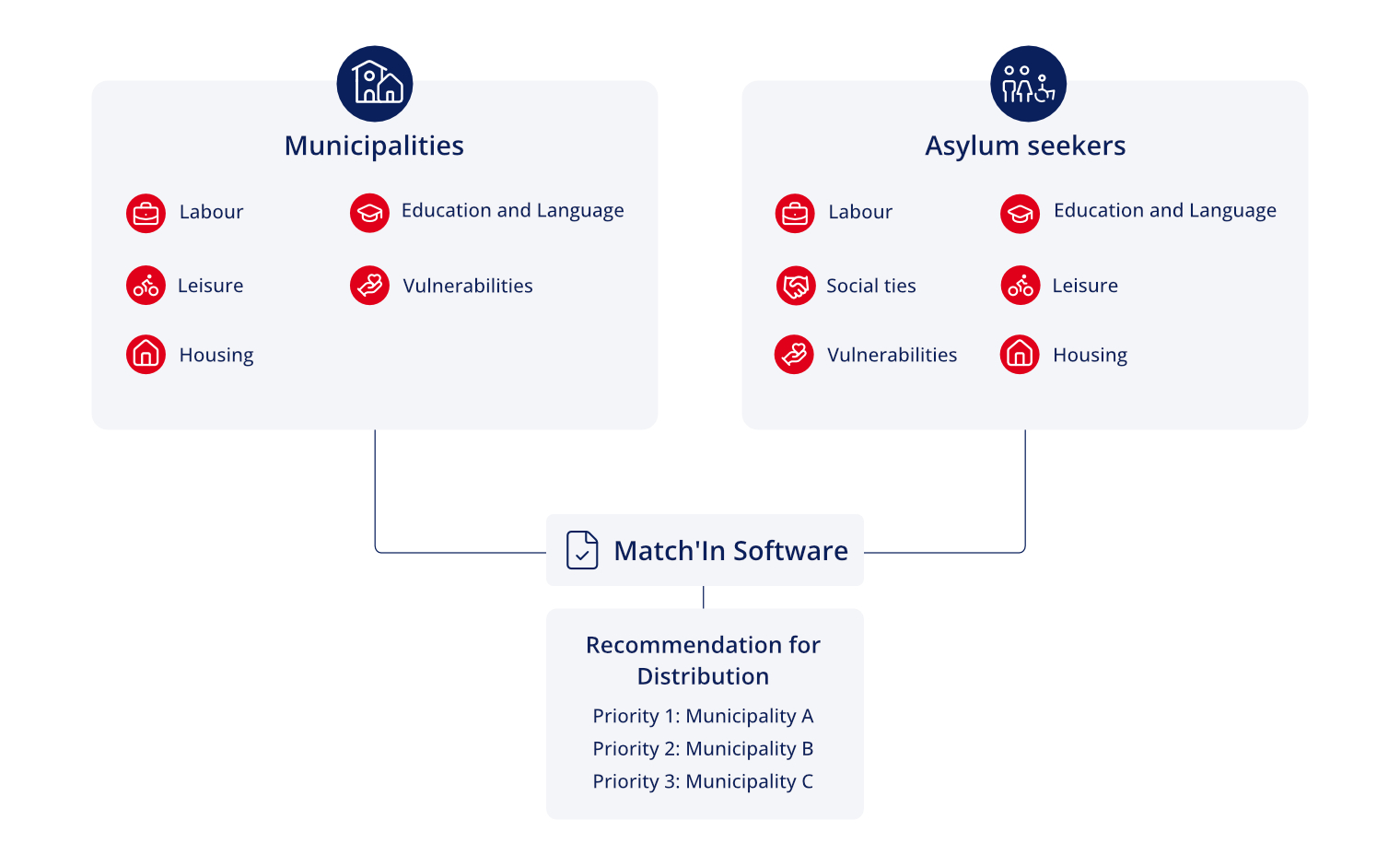
The Match’In pilot project focuses on the allocation of asylum seekers from the federal states to the municipalities: How can the distribution process be organized in such a way that both the needs of asylum seekers and the conditions in the municipalities are taken into account?
The starting point
Lack of knowledge about needs
When assigning refugees, personal needs or existing resources of those seeking protection have hardly been systematically recorded to date.
Unknown conditions
The conditions prevailing in the host communities are also not systematically taken into account in the assignment process.
Random starting opportunities
Whether those seeking protection find good opportunities for successful participation locally is currently largely left to chance.
What does Match'In do?
As part of the Match’In project, the universities of Hildesheim and Erlangen-Nuremberg, together with four federal states, have developed an algorithm-based procedure that systematically identifies the individual needs and requirements of those seeking protection as well as the conditions in the receiving municipalities. Based on this information, proposals are made for the distribution of refugees.
A total of over 60 criteria are included in the allocation process. These were determined based on findings from migration research as well as an exchange with various experts, including asylum seekers as experts in their own right, experts for special protection needs, and representatives of allocation authorities and local communities.
Examples of criteria deemed relevant for refugees include health needs, available resources (educational qualifications, language skills, work experience), family relationships and preferences (e.g. hobbies or desire for accommodation close to nature). On the municipal side, structural data (e.g. on the housing and labour market) and existing support structures are taken into account.
Goals of Match'In
After all data has been collected via digital questionnaires, a software compares the needs of those seeking protection with the conditions offered by the host municipalities and then ranks the municipalities according to how well they match the requirements of the person concerned. This ranking then serves as a distribution proposal for the authorities responsible for the allocation.
Targeted allocation
By systematically taking into account the needs of those seeking protection and the host communities, the allocation process becomes more precise, efficient, and better tailored to actual requirements.
Confident decisions
Informed administrative decisions facilitate the exercise of discretionary powers and increase legal and technical certainty in administrative actions.
Better integration
Needs-based allocation improves the integration and participation opportunities of those seeking protection and supports their sustainable arrival in the communities.
High transparency
A comprehensible procedure and freely accessible software and materials make processes transparent, understandable, and verifiable for all involved.
Broad participation
The early and continuous involvement of those seeking protection, experts, and local actors promotes acceptance, trust, and shared responsibility.
The funding phases of the project
The Match’In pilot project consists of two funding phases, each with a different focus:
MatchIn 1.0
From 2021 to 2025, in the first funding phase (Match’In 1.0), the universities of Hildesheim and Erlangen-Nuremberg, along with four selected federal states, developed the algorithm-based procedure with funding from the Mercator Foundation. The procedure was then tested in real conditions in over 20 municipalities involving adult asylum seekers travelling alone, and this was accompanied by scientific research.
The current funding phase, Match’In 2.0 (2025–2027), builds on the results of the first funding period. It comprises two sub-projects funded by the Rhineland-Palatinate Ministry for Family, Women, Culture and Integration and the Hesse Ministry of Labour, Integration, Youth and Social Affairs. This phase has two core objectives: expanding the algorithm-based procedure for family networks (Rhineland-Palatinate sub-project) and programming of an app accompanying the procedure (Hesse sub-project).
Wir verwenden Cookies, um unsere Website und unseren Service zu optimieren.
Funktional
Always active
Die technische Speicherung oder der Zugang ist unbedingt erforderlich für den rechtmäßigen Zweck, die Nutzung eines bestimmten Dienstes zu ermöglichen, der vom Teilnehmer oder Nutzer ausdrücklich gewünscht wird, oder für den alleinigen Zweck, die Übertragung einer Nachricht über ein elektronisches Kommunikationsnetz durchzuführen.
Vorlieben
Die technische Speicherung oder der Zugriff ist für den rechtmäßigen Zweck der Speicherung von Präferenzen erforderlich, die nicht vom Abonnenten oder Benutzer angefordert wurden.
Statistiken
Die technische Speicherung oder der Zugriff, der ausschließlich zu statistischen Zwecken erfolgt.Die technische Speicherung oder der Zugriff, der ausschließlich zu anonymen statistischen Zwecken verwendet wird. Ohne eine Vorladung, die freiwillige Zustimmung deines Internetdienstanbieters oder zusätzliche Aufzeichnungen von Dritten können die zu diesem Zweck gespeicherten oder abgerufenen Informationen allein in der Regel nicht dazu verwendet werden, dich zu identifizieren.
Externe Medien
Die technische Speicherung oder der Zugriff ist erforderlich, um Nutzerprofile zu erstellen, um Werbung zu versenden oder um den Nutzer auf einer Website oder über mehrere Websites hinweg zu ähnlichen Marketingzwecken zu verfolgen.